May 22, 2026 - 890 views
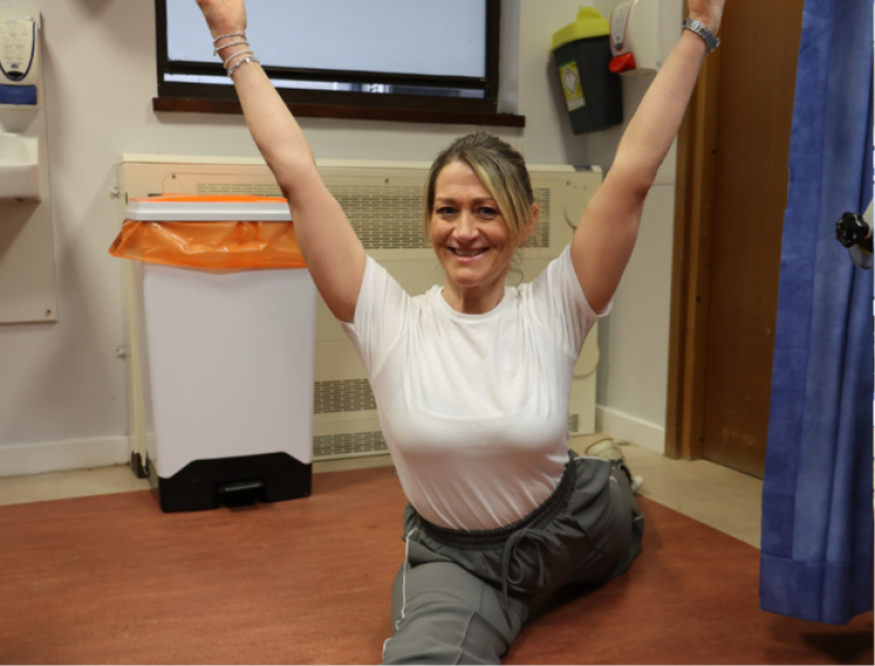
A North Wales patient who feared she would never dance again has praised staff at Ysbyty Gwynedd after returning to the stage just months after undergoing pioneering hip replacement surgery.
Sarah Woosey, a veteran performer who has appeared in West End productions and cruise ship shows, underwent a minimally invasive hip replacement operation earlier this year after painful arthritis left her struggling to continue dancing.
The surgery was carried out by Consultant Orthopaedic Surgeon Muthu Ganapathi using a technique known as the direct anterior approach with a “bikini incision”.
Unlike traditional hip replacement surgery, the muscle-sparing procedure works between muscles rather than cutting through them, helping suitable patients recover more quickly and regain mobility sooner.
Just over three months after her operation, Sarah was back performing in a dance concert — something she once feared would never happen again.
Now, one year on from the surgery, she has returned to the Bangor hospital to personally thank the team who supported her recovery.
Sarah said before the operation she was living with constant pain and worried her performing career had come to an end.
“The care I received was incredible,” she said.
“The team made me feel so supported throughout, and I’ll always be grateful for that.
“To be back dancing again within a few months and now, a year on, feeling strong and pain-free is just amazing. Coming back to say thank you in person was really important to me.”
Alongside her professional performing career, Sarah also runs a local dance school where she encourages young people to pursue their passion for dance.
Mr Ganapathi said the direct anterior approach is now being introduced at Ysbyty Gwynedd for selected patients and can offer significant benefits during the early stages of recovery.
“By working between the muscles rather than cutting through them, it can help to reduce pain after surgery and support a quicker recovery,” he explained.
He added that although the technique is widely used in countries such as the United States, it remains relatively uncommon in the UK, accounting for fewer than two per cent of hip replacements nationally.
Mr Ganapathi also noted that the usual movement restrictions often associated with conventional hip replacements are generally not required following the direct anterior approach because the risk of dislocation is lower.
He described Sarah’s progress as “fantastic”, while stressing that her recovery had also been helped by her high level of fitness and determination.
Health leaders say advances in minimally invasive orthopaedic surgery are helping improve recovery times and patient experiences across the NHS, with hospitals increasingly exploring techniques that allow patients to return to normal life more quickly following joint replacement procedures.