April 17, 2026 - 1014 views
A chance encounter on a train — and an unexpected discovery in a magazine — has led to a scientific partnership spanning more than two decades and culminating high on the slopes of Mount Everest.
For Professor Bryn Hubbard, of the Centre for Glaciology at Aberystwyth University, the collaboration with Conwy-based Robertson Geo began entirely by chance.
“I was travelling back to Aberystwyth, picked up a magazine and it introduced me to Robertson Geo and its televiewer,” he said. “I had no idea this technology even existed.”
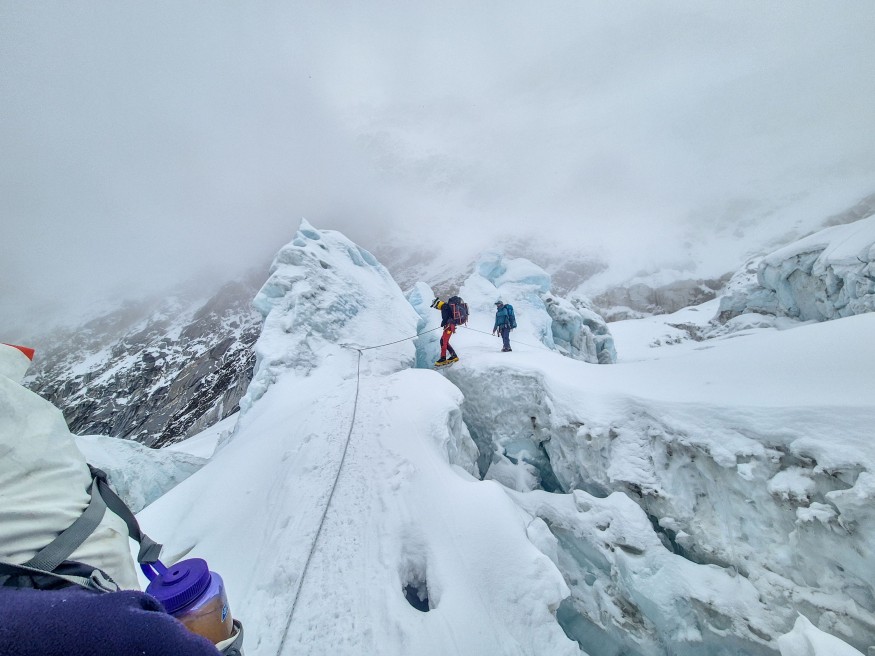
That moment would prove transformative — eventually leading to one of the most ambitious glaciological expeditions ever undertaken. Professor Hubbard went on to lead a team to the Khumbu Glacier, deploying advanced imaging technology at an altitude of 6,660 metres.
The expedition formed part of the NERC-funded “Losing their Cool” programme and saw researchers use a lightweight televiewer system to capture high-resolution images inside the glacier, alongside collecting core samples and meteorological data.
Operating in extreme conditions — with oxygen levels less than half those at sea level and temperatures plunging below -25°C — the team relied on Robertson Geo’s equipment to perform without modification.
Dr Matthew Peacey, who took part in the मिशion, said reliability was crucial.
“When you’re working at that altitude, every piece of kit has to work first time. Robertson Geo’s technology did exactly that — reliably, in some of the most hostile conditions on Earth,” he said.
Professor Hubbard added: “It really changed everything. The televiewer enabled us to see inside glaciers in unprecedented detail. Robertson Geo has played a huge part in that journey.”
The Everest project marks the peak of a collaboration dating back to the early 2000s, when the company’s High Resolution Optical Televiewer was first introduced to glaciology. Since then, the partnership has supported research across the Arctic, Antarctic, Andes and Himalayas, including previous expeditions to the Everest region in 2017 and 2018.
Early findings from the latest मिशion are already reshaping scientific understanding. Researchers have identified unexpectedly warm firn (compacted snow), alongside clear signs of melting and refreezing. Data has also revealed complex internal ice structures, offering new insight into how glaciers behave and evolve.
The implications are significant. Between 1977 and 2010, Himalayan glaciers lost around a quarter of their area and nearly a third of their volume. These glaciers provide freshwater to more than 10% of the global population, and scientists warn the region could be nearing “peak water” — the point at which meltwater supplies begin to decline.
With headquarters in Conwy and operations in the United States and Hong Kong, Robertson Geo exports the vast majority of its products and works in more than 160 countries.
Managing director Simon Garantini said the company was proud to support research with global importance.
“We’ve built a strong partnership with Professor Hubbard’s team over many years. Seeing our technology perform at the extremes — and contribute to critical climate science — is incredibly rewarding.”
Further expeditions to the Himalayas are already planned for 2026, while Professor Hubbard is set to travel to Greenland this summer — again working alongside Robertson Geo — as the long-running partnership continues to push the boundaries of climate science.
For more news and information from Robertson Geo, visit the website Geotechnical - Robertson Geo | Wireline Borehole Logging.